Tag Archives: InfraSource

Good Catch: Defective Gloves Identified

Our Good Catch Program continues to highlight our employees who stay vigilant and identify potential hazards. By utilizing the energy wheel, our team thoroughly inspects and identifies STKY (Situations That Kill You) scenarios, leading to countless safety success stories. Our commitment to safety and precision continues to shine through the diligent efforts of our teams.

Coordination and Communication

Recently, an InfraSource NE Small Job Foreman (SJF) was performing an air test and inspection on his Class 2 rubber gloves when he discovered a defect in the rubber. These were new gloves, straight out of the box. The SJF initially performed an air test with an inflator and found no air leaks. However, during a subsequent visual check, the defect was detected.

Identifying and Resolving the Defect

This discovery underscores the importance of thorough testing and inspection of safety equipment before each use. The defect in the gloves could have posed a significant risk if not identified. Thanks to the vigilance and attention to detail of our team, this potential hazard was caught and addressed promptly.

Preventing Safety Hazards

This incident highlights the critical role of accurate and diligent inspection in preventing safety hazards and ensuring the reliability of our safety gear. The proactive measures taken by the InfraSource foreman exemplify our ongoing commitment to excellence and safety in all our operations.

Kudos to the team for their dedication and attention to detail, ensuring that our employees are equipped with safe and reliable gear.

Good Catch: InfraSource Crew Prevents Potential Hazard

Our Good Catch Program continues to highlight our employees who stay vigilant and identify potential hazards. By utilizing the energy wheel, our team thoroughly inspects and identifies STKY (Situations That Kill You) scenarios, leading to countless safety success stories. Our commitment to safety and precision continues to shine through the diligent efforts of our teams.

Critical Safety Discovery

During a routine pole replacement and the installation of a new Normal Open Viper, an InfraSource crew made a critical safety discovery. While installing the VCR, the crew noticed that the center bushing was pointed downward. Acting swiftly, the Site Job Foreman (SJF) called for a Stop Timeout and alerted the General Foreman (GF).

Inspection and Resolution

Upon further inspection and discussion with the Construction Supervisor (CS), it was determined that the bushing’s position was unsafe for service. The crew disassembled the bushing and found that the brass break-away stud inside was broken in half. Recognizing the potential hazard, parts were promptly ordered, and repairs will be conducted in the field.

Commitment to Safety

This proactive identification of a serious issue before the VCR was put into operation highlights the crew’s dedication to safety and excellence. Kudos to the InfraSource team for their vigilance and quick action in preventing what could have been a significant problem. Their commitment ensures the continued reliability and safety of our services.

Good Catches: Ensuring Accuracy in Scheduled Outages

Our Good Catch Program continues to highlight our employees who stay vigilant and identify potential hazards. By utilizing the energy wheel, our team thoroughly inspects and identifies STKY (Situations That Kill You) scenarios, leading to countless safety success stories. Our commitment to safety and precision continues to shine through the diligent efforts of our teams.

Coordination and Communication

Recently, an InfraSource crew was assigned the critical task of transferring #6 copper primary to a new pole. This line is essential as it supplies power to the city water pumps, necessitating the use of generators during the outage. The General Foreman (GF) took proactive steps to coordinate with the Water Authority, informing them of the scheduled outage and assuring them they would receive a confirmation letter. However, when the customer contacted the GF to verify the dates, they noted a discrepancy: their letter listed an incorrect date for the outage, with an incorrect rain date as well.

Identifying and Resolving the Discrepancy

Upon consulting with the work planner, it was determined that the system had generated incorrect dates. This discrepancy could have led to an unplanned outage, potentially leaving the entire city without water. Thanks to the vigilance and thorough communication of our team, this critical error was identified and corrected in time.

Preventing Unplanned Outages

This incident underscores the importance of accurate documentation and communication in preventing unplanned outages and ensuring the safety and reliability of our services. The proactive measures taken by the InfraSource dock crew highlight our ongoing commitment to excellence and safety in all our operations.

Kudos to the team for their dedication and attention to detail, ensuring that our customers receive the reliable service they depend on.

InfraSource’s Women’s Employee Resource Group Celebrates Women in Construction Week

March 2-8 is Women in Construction Week™(WIC). Established by the National Association of Women in Construction (NAWIC) in 1998, WIC celebrates and promotes the role of women in the construction industry. 

What better time to spotlight our Women’s Employee Resource Group (ERG)? This group kicked off in December 2024 with the mission to foster inclusivity and support women within the organization. The ERG has adopted the name LIFT, which stands for Leading Infrasouce Females Together. 

A Vision for Support and Representation
The idea for the Women’s ERG began with Stephanie Krabbe, Senior Vice President of Organizational Development, who recognized the need for more support and representation for women in the construction industry. “The goal of creating the Women’s ERG is to foster an inclusive environment that supports the professional and personal development of women within our organization,” she explains. “It provides a space for women to connect, share experiences, and access resources that can help them advance in their careers.”

Meet the LIFT Leadership Team

InfraSource’s Women’s ERG is led by a passionate group of women, including Chair Danie Adamic, Vice-Chair Holly Luehring, Communications Chair Marissa Sitton, and Membership Chair Shaun McGuire. Each brings a unique perspective and a shared commitment to empowering women at InfraSource.

  • Danie Adamic, Chair, began her journey at InfraSource nine years ago as a fuser. Now an OQ Evaluator, she’s dedicated to inspiring women to step outside their comfort zones. “You don’t know what you can do unless you try,” she says, encouraging others to be bold and take risks.
  • Holly Luehring, Vice-Chair, started her 25-year career in construction as a marketing intern. With the help of mentors and allies, she built a successful career by taking on new challenges and continually learning. Holly envisions the ERG as a space where women can uplift and support each other. “Don’t be your own roadblock. Take a chance and believe in yourself,” she advises.
  • Shaun McGuire, Membership Chair, brings 16 years of experience in the auto industry to her role as Fleet Coordinator at InfraSource. With a focus on connecting women across the company, Shaun is committed to fostering growth and mentorship.
  • Marissa Sitton, Communications Chair, is the corporate fleet manager who manages the company’s fleet operations. She’s eager to create open communication channels and facilitate collaboration within the ERG.

Building a Culture of Empowerment

The Women’s ERG is a platform for building confidence, sharing knowledge, and creating opportunities for women at InfraSource. United by a shared passion for mentorship and advocacy, the group is paving the way for a more inclusive workplace.

As the ERG grows, it will not only provide support for women at InfraSource but will also inspire the development of additional employee resource groups. Ultimately, it’s all part of the company’s commitment to creating a positive workplace culture.

Look for more from the LIFT this week as the group takes over our social feeds.   

INFRASOURCE LIFT LOGO

Good Catches: Adapting to Daily Changes on the Job

Our Good Catch Program continues to highlight our employees who stay vigilant and identify potential hazards. By utilizing the energy wheel, our team thoroughly inspects and identifies STKY (Situations That Kill You) scenarios, leading to countless safety success stories. Kudos to all the crews who mitigate daily STKY situations.

Catching a Critical Error
A crew began work on an interruption on a circuit. During a manhole inspection, the team noticed a discrepancy in the gas-operated switch tag’s clearance order (CO) number; the number on the switch didn’t match the Clearance Order. After contacting the Operations Control Center, they discovered a new CO had been issued for an inoperable switch. This catch highlighted a lock-out tag-out violation, emphasizing the importance of accurate documentation and communication.

Preventing a Fire Hazard
A crew was tasked with replacing an open wire service with a triplex. They found the customer’s service entry cable insulation had deteriorated, posing a fire hazard. The team de-energized the service, made temporary repairs, and ensured the customer’s power remained on during freezing temperatures. The customer was advised to contact an electrician for permanent repairs, with follow-up planned to ensure safety.

Avoiding Utility Conflicts
While setting a new service pole, a crew noticed a private storm drain in the path of the new pole. They moved the pole to a different location and scheduled a Vac Truck to dig the hole, ensuring no utility conflicts.

Addressing Changing Conditions
A crew tasked with replacing a pole noticed a tree in the Right-of-Way that had uprooted during recent storms, posing a risk of unscheduled outages. They reported the issue, and a trouble ticket was created to clear the Right-of-Way, showcasing how conditions can change daily on the job.

Addressing a Split Pole
A crew was tasked with replacing a pole and transferring facilities. During their inspection, they noticed the adjacent dead-end pole was split at the top. They performed a Stop Timeout and decided to install split bolts on the pole before moving the primary at the assigned pole. This proactive measure ensured the safety and stability of the structure.

Identifying and Resolving Multiple Issues
A crew was assigned to move secondaries to a new required height. Before framing for the new attachment, they noticed an old porcelain cutout. It has become standard practice to check these cutouts for cracks, as they can easily break. Upon inspection, they found the arm was completely rotten. The crew performed a Stop Timeout and contacted their Foreman.

When the crew went up to put rubber on for the pole set, they noticed the cross arm was completely rotted on top and needed to be changed before setting the new pole. They performed another Stop Timeout to change the scope of work. After making the existing arm safe and setting the new pole, the crew removed the existing transformer bank. During this process, they discovered one of the mounting brackets was broken off and another was cracked and in poor condition. The crew performed yet another Stop Timeout to adjust the scope of work obtained two new transformers and completed the job safely and efficiently.

Project Spotlight: HPFF Utility Hole Emergency Repair

INTRODUCTION

During the week of Thanksgiving, a third-party contractor inadvertently damaged an existing 138kV high-pressure fluid-filled circuit in Philadelphia, resulting in a leak of dielectric fluid near the manhole wall. InfraSource was promptly notified and mobilized civil crews to address the issue. The entire repair process was completed within 12 days of the initial notification of the damage.
SCOPE OF WORK

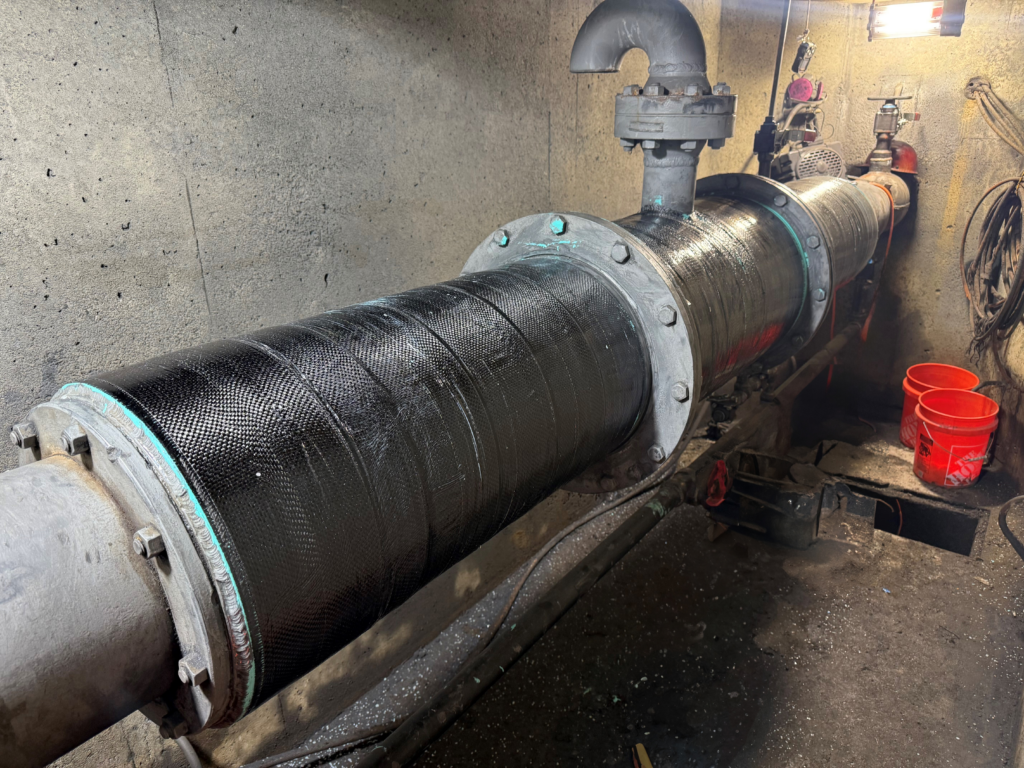
InfraSource crews excavated the manhole wall and removed the concrete around the existing pipe to assess the damage. A temporary clamp was applied to control the leak. The repair consisted of removing existing hydraulic bypass piping and installing a welded sleeve repair. All new bypass piping and valves were installed, vacuum pulled, and the line was refilled. Carbon fiber Atlas Wrap coating was applied to the sleeve of the pipe, and heat shrink and wax tape coatings were applied to the rest of the exposed pipe for protection.

Our dedicated team brings over 100 years of combined experience installing underground high-voltage transmission lines. Contact us to learn more.

A pipe underground.
InfraSource fixing a pipe underground.

Project Spotlight: Plymouth 138/147 Mainstem Replacement

InfraSource has successfully delivered various solutions to the Electric Distribution and Transmission industry, and our team brings over 100 years of combined experience installing underground high voltage transmission lines.

With the completion of this job in Plymouth, Pennsylvania, the crew successfully reduced the likelihood of disruption, leaks, failures and other hazards associated with outdated infrastructure.

Before starting work, the team conducted a thorough inspection of the existing infrastructure to determine its condition and the necessary work. They checked for any potential hazards, existing utilities and environmental concerns that could affect the process.

This project involved the installation of several complex components, including about 10,000 feet of four to five-inch duct package, one manhole, 24, 207-feet of three phase cable, elbow sets, two underground switches and six poles.

The crew used cold splicing to join wires and cable and interruption splicing to join conductors. These required strict adherence to safety protocols due to exposure to high voltages – particularly interruption
splicing, as it is performed while systems are live.

Aerial terminations were performed to connect the overhead lines to the power grid. These had to be Carefully done with safety protocols at the forefront due to the high voltage involved, and the fact they have to be able to withstand wind, rain and ice.

Project Spotlight: Coy Road Widening & Gas Main Relocation

This newer project we worked on was located in Oregon, a suburb of Toledo, Ohio. The city of Oregon needed assistance replacing two gas lines during a road widening project. The project would widen Coy Road, one of Oregon’s major streets, by about five feet, resurface the existing asphalt pavement and replace missing sections of sidewalk.

The completion of the project helped the City of Oregon improve traffic flow, safety and accessibility in the community.

The team successfully moved 63 services and relocated 1,452 feet of two- and four-inch-high pressure steel and 4,957 feet of two, four and six-inch plastic gas mains.

Project Spotlight: Fault Locate & Repair

The purpose of this project in Haverford, Pennsylvania, was to fix a faulted underground electric cable in a residential neighborhood. Repairing the cable would prevent further damage to the cable or surrounding infrastructure and enhance the reliability of the electrical distribution system.

When the team got to the location, they used a Mega Beast 80-amp service tester and SPITFIRE secondary fault locator to pinpoint the location of the underground cable fault.

Once the fault was located, the team cut out the damaged portions of the cable and spliced them together using four connectors. Three feet of heatshrink tubing was placed over the splices and heated to conform closely to the cable and splices, insulating the material. Lastly, the repaired cable was tested to ensure it was secure and functioning correctly.

InfraSource crews worked tirelessly to repair the fault, ensuring disruptions to homes and businesses were
kept to a minimum. They successfully prevented a hazardous situation from occurring and reduced the likelihood of future outages.

Project Spotlight: 3201 Cuthbert Street

For this big project, the team was called on to install underground conduits to a new building on the Drexel University campus. The building is set to house the largest life sciences facility in the city.

Before laying conduits, the team located any existing underground utilities and made sure the site was cleared to ensure a safe working environment. They used a mini excavator to dig the trenches, making sure they were deep enough to meet local codes and wide enough to fit the conduit and allow for
backfilling.

Conduit in various sizes were installed, including 180 feet of 10.5-inch, 218 feet of 12.5-inch and 72 feet of
14.5-inch.

With the conduits underground, they will be less susceptible to wear and tear, lasting longer and requiring less maintenance for the university.